Responsible industry as a competitive advantage: Outokumpu shows the way
The transformation of the mining and metals industry, practical approaches to sustainability, and the role of raw materials in Europe’s future are examined from Outokumpu’s perspective.
27. May 2026
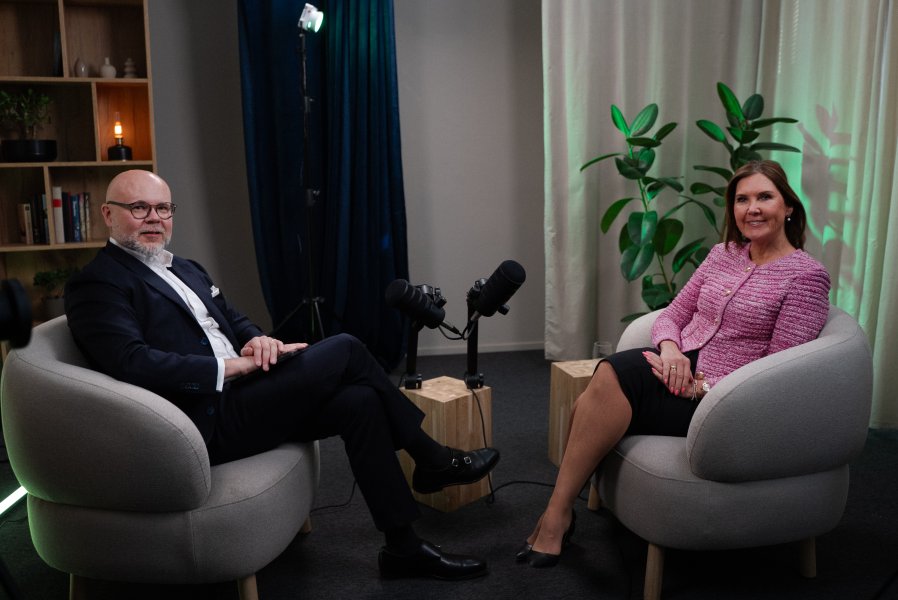
In the fifth episode of our podcast, we take a closer look at modern mining and metals production. The discussion explores Outokumpu’s strategy, the role of mining and metals processing in Finland, and the impacts of sustainability requirements, security of supply, and geopolitical uncertainty.
FMG’s CEO Matti Hietanen is joined by Kati ter Horst, President and CEO of Outokumpu.
Kemi chrome mine and new technologies as a foundation for growth
Today, Outokumpu is known for producing stainless steel. While the company has divested many of its mines over time, it retained the Kemi chrome mine. Today, the Kemi mine is the only chrome mine in the EU. Between 2017 and 2023, the company invested nearly EUR 300 million in the mine, extending production to a depth of one kilometre.
At the core of Outokumpu’s new strategy is maximizing the value of stainless steel while expanding into advanced materials and innovative technologies. Growth is also being pursued through ferrochrome as a standalone business.
Outokumpu is currently testing a method in the United States that could fundamentally reshape views on mining.
“We have a large chrome mine with significant chrome ore reserves. The only downside is that the chrome content is 53%. With this new technology, we could achieve products with a chrome content of over 65%, even up to 90%. This is the kind of value creation that technology can deliver, and it will likely work for other metals such as nickel as well,” ter Horst explains.
Circular economy and low emissions as competitive strengths
In addition to technology, sustainability is a key competitive advantage for Outokumpu. Production is based on more than 90% recycled materials, and the carbon footprint of its stainless steel is 75% lower than the industry average.
High recycling rates, efficient ferrochrome production in Kemi, and low-emission Nordic electricity enable an exceptionally low carbon footprint. The carbon footprint of the company’s Circle Green products is 90% lower than the industry average. The EU’s Carbon Border Adjustment Mechanism (CBAM) also supports low-emission production.
“The carbon border adjustment has cut Asian imports to Europe by half, shifting demand toward European producers with lower carbon emissions,” says ter Horst.
Outlook for the chrome mine and the mining sector
As the only chrome mine in the EU, ter Horst sees a positive future for the Kemi operation. Chrome is needed not only for stainless steel but also for the defence industry due to its high heat resistance. With current investments, mineral reserves are expected to last into the 2050s, according to ter Horst.
The public image of mining in Finland often lags behind reality, even though modern operations like the Kemi mine are fully underground, operate without chemicals, and respect environmental values. Perceptions of mining work also need updating, as an increasing share of operations is controlled remotely from above ground using automation.
Ter Horst emphasizes that we live in a physical world that cannot exist without metals and minerals.
“I would much rather see minerals and metals, since they are needed, being mined responsibly in a country like Finland, rather than imported from places where there may be little concern for how they are produced,” she stresses.
Mining value chains as cornerstones of growth
According to ter Horst, the value chains created around mining could become a major driver of growth for Finland. Historically, global success stories such as Nokia and Kemira have emerged from the sector.
However, realizing this potential requires long-term, predictable policymaking. For example, the unexpectedly introduced mining mineral tax weakens the investment climate and the competitiveness of domestic downstream processing.
“Finland needs an industrial strategy and an energy strategy. We need to decide what kind of investments we want to attract. When decisions come out of the blue, it does not build much confidence to invest in Finland,” ter Horst notes.
The fifth episode of our Mineraalit ja miljardit podcast series is titled Responsible industry as a competitive advantage – Outokumpu’s outlook. Listen to the episode on FMG’s YouTube channel (English subtitles)!
What did you think of the episode? We welcome your feedback and ideas for future topics and guests.