Long-term industrial policy safeguards investments: Boliden calls for stability
Boliden shares its perspectives on the operating environment of a European mining company, the differences between Finland and Sweden as investment destinations, and the impacts of regulation and taxation on the competitiveness of the mining sector.
16. June 2026
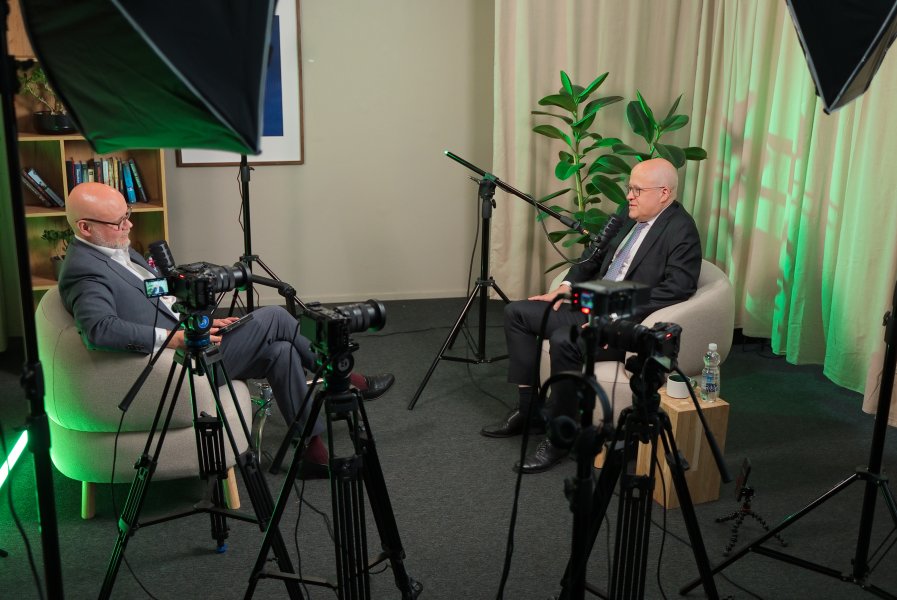
The sixth episode of our podcast explores the future direction of the European mining and metals industry and what it takes to lead a global industrial company in a rapidly changing world. The discussion covers Boliden’s operations in Finland, the societal significance of the Kevitsa mine, and the long-term impacts of mining taxation.
FMG’s CEO Matti Hietanen is joined by Mikael Staffas, President and CEO of Boliden.
Differences between Finland and Sweden as operating environments
Founded over a century ago, Boliden is Europe’s largest mining and smelting company for base metals. Approximately half of its operations are in Sweden, and around 25 percent are now located in Finland. Despite its significant presence in Finland, only about one percent of the company’s shares are Finnish-owned. Boliden’s Kevitsa mine, one of the largest taxpayers in Lapland, directly employs 500-600 people.
The company has extensive experience operating across the Nordic countries. Historically, Finland has been seen as more pragmatic and flexible than Sweden in permitting processes, but according to Staffas, the situation has shifted. Sweden has managed to streamline its bureaucracy, while regulation and processes in Finland have become more burdensome from a business perspective.
Finland’s mining tax affects the competitiveness of the entire value chain
Changes in the operating environment are reflected in investment decisions. For example, the life cycle of the Kevitsa mine could be extended until 2043 with an investment of approximately one billion euros. However, tighter mining taxation in Finland and a sharp increase in electricity taxes for mines have led to delays in decisions on further investments.
Rising costs and taxation do not affect only mining operations; they also directly impact downstream processing. For instance, the Harjavalta smelter sources a significant share of its raw materials from Kevitsa, with the remainder procured from global markets in competition with players such as Chinese operators. As a result of the mining tax, mining activity in Finland is expected to decline.
“Keeping smelter operations in Europe is extremely difficult, especially if existing mines are shut down. It does not feel good when substantial investments have already been made and the rules of the game are suddenly changed halfway,” Staffas notes.
Sustainability is an integral part of modern mining
Alongside economic conditions, sustainability is essential to Boliden’s operations. It encompasses social, economic, and environmental responsibility.
“We cannot operate at all unless we and our impacts are accepted by both society and the environment,” Staffas emphasizes.
Despite being part of a heavy industry, the company has operated for 18 consecutive years without a fatal accident—an exceptional achievement on a global scale. Environmental impacts are monitored through tens of thousands of measurement points to minimize deviations from permit conditions.
The public image of the mining sector still lags behind reality, even though modern mining is increasingly high-tech and diverse work. According to Staffas, the environmental footprint of the industry may also be overstated: for example, in Sweden, the water discharged into the sea from the Rönnskär smelter is cleaner than the natural water in a nearby river.
EU self-sufficiency requires long-term industrial policy
As the EU aims to secure access to critical raw materials, the Nordic countries have a significant role to play. Staffas calls for stronger EU support for local supply chains rather than relying solely on imports from countries such as Indonesia. However, leveraging local value chains and attracting investments require long-term commitment from governments.
“Finland lacks an industrial policy. The country needs a coherent policy that extends beyond different government coalitions. No one builds a mine within a single electoral term,” Staffas concludes.
The sixth episode of our podcast is titled Boliden and the future of critical minerals. Listen to the episode on FMG’s YouTube channel.
What did you think of the episode? We welcome your feedback, as well as ideas for future topics and guests.