Mining and battery industry in the midst of technological transformation
The current state and future outlook of the mining and battery sectors are examined through the lenses of technological development, research, and education.
07. May 2026
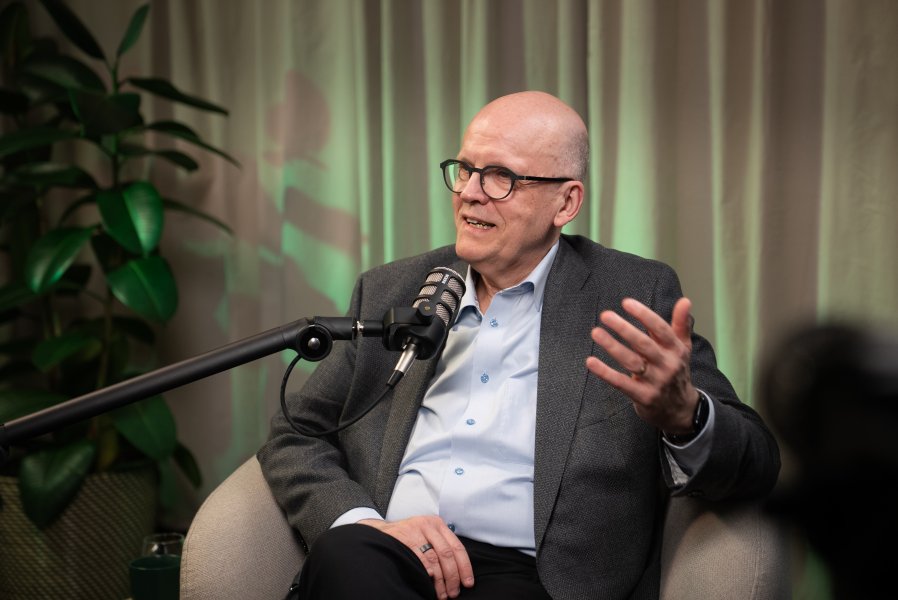
In the fourth episode of our podcast, we take a closer look at how new technologies, research, and education are shaping the mining and battery industries—and what kinds of opportunities they create for Finland’s economic growth. The episode focuses in particular on the impacts of artificial intelligence and quantum computing on the industry, as well as on how the future skills needs of the sector can be secured.
FMG’s CEO Matti Hietanen is joined by Antti Vasara, a versatile expert in science and technology. Vasara serves on the boards of several growth companies, is a member of the European Innovation Council, acts as Finland’s Technology Ambassador at the Ministry for Foreign Affairs, and chairs the Board of the University of Helsinki.
Artificial intelligence and quantum computing are transforming industrial processes and productivity
We are living in a period of profound technological change. Vasara describes today’s AI tools as “probability machines” that require vast amounts of computing power and energy to operate. Alongside AI, quantum computing is developing rapidly and enables exponentially greater computing capacity by processing multiple variables simultaneously.
According to Vasara, these technologies also have a direct impact on the mining and battery sectors. Physical AI applications, such as robotics, can improve occupational safety by transferring the most hazardous tasks from humans to machines. In addition, AI can optimize process data, while new sensor technologies can support mineral exploration.
Although rapid technological development also raises concerns about replacing human labour, Vasara emphasizes that people will still be needed to verify outputs and assess their use cases.
“AI makes it possible to remove routine work. AI doesn’t take your job, another person who knows how to use new tools better does,” Vasara summarizes.
The growing need for critical raw materials highlights the importance of resilient value chains
Rapid technological development and a tightening geopolitical landscape are changing how we think about raw materials. The long-held assumption in Europe that minerals and components can always be sourced from elsewhere has reached its limits. For example, the construction of data centres and quantum computers requires critical materials such as aluminium. As geopolitical tensions increase, countries now need to actively secure the origin of their raw materials and build resilient value chains.
The battery industry has also become more aware of the competitive landscape. China’s significant lead in both production scale and research is forcing Europe and Finland to innovate. According to Vasara, simply catching up would require massive investments, so the solution lies in finding new angles and potentially new battery chemistries.
Securing talent through close cooperation with educational institutions and increased sector visibility
Education plays a critical role in driving technological transformation and the green transition. The University of Helsinki is a key player in the field, educating around half of Finland’s geologists and nearly all geophysicists. Although the number of applicants in these fields is increasing, career opportunities in mining and battery industries are still not fully recognized. Vasara calls on industry players to take a more active role in articulating the modern nature and importance of the sector to future talent.
“This is no longer a field where some guy is out there wearing a helmet and holding a pickaxe. The nature of work has changed,” Vasara emphasizes, adding that the importance of domestic mineral resources and their sustainable use should also be communicated more actively.
As a practical solution, he suggests strengthening collaboration between universities and companies, for example by actively offering internships and thesis topics and supporting education through endowed professorships.
A stable society is Finland’s competitive advantage
Discussions around the mining and battery industries increasingly highlight security, geopolitics, and the green transition. Growing demand for minerals is accelerating the sector, while at the same time placing greater emphasis on strict sustainability requirements within planetary boundaries. Resilience and security considerations are prompting governments and companies to carefully assess where raw materials are sourced from. In this transition, Finland has opportunities for economic growth.
“Finland has well-functioning societal structures and a stable political system. We appear to be a very reliable partner for many countries,” Vasara concludes.
The fourth episode of our Mineraalit ja miljardit podcast series is titled Technology is transforming industry – AI, expertise, and opportunities for Finland’s growth. Listen to the episode on FMG’s YouTube channel.
What did you think of the episode? We are happy to receive feedback and ideas for topics and guests for future episodes.