Significant untapped potential remains in Finland's bedrock
In our podcast, GTK’s Saku Vuori discusses the untapped potential of Finland’s bedrock and the importance of strengthening Europe’s raw material self-sufficiency.
07. October 2026
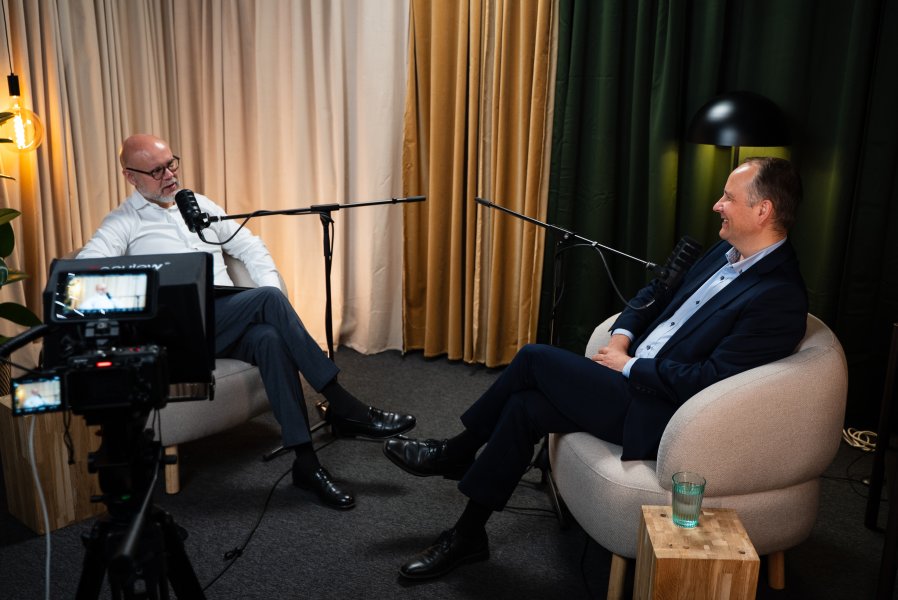
In the eighth episode of our podcast, we discuss what could still be discovered in Finland’s bedrock and what role Finland can play as Europe seeks to become more self-sufficient in raw materials.
FMG’s CEO Matti Hietanen is joined by Saku Vuori, Director General of the Geological Survey of Finland (GTK).
Much remains to be explored beneath the surface
Although geological research has a long history in Finland, most of the country’s bedrock remains covered by thick layers of soil, mires and lakes. According to Vuori, only around three per cent of the bedrock is directly exposed at the surface and available for study.
Mineral exploration is continuously evolving with advances in technology. Modern geophysical survey methods and other exploration technologies allow us to look deeper and deeper into the bedrock. At the same time, it is important to understand that modern mineral exploration is carried out with respect for the environment. According to Vuori, early-stage exploration may leave little more than rolled-up moss behind, and efforts are also made to minimise the impact of drilling sites.
“Exploration companies need to feel that their activities are accepted, that society allows them and, indeed, wants new mines to be developed. Without that kind of outlook, mineral exploration is unlikely to really take off,” Vuori says.
Finland punches above its weight in metals processing in Europe
Finland holds an exceptional position in Europe when it comes to the production of critical raw materials. Our bedrock contains several minerals that are important to the EU, including lithium, nickel, cobalt and graphite. At the same time, Europe consumes a significant share of the world’s raw materials but produces only a fraction of them itself.
Finland’s role is not limited to mining. The country is also a significant processor of metals, with concentrates imported from around the world for further processing in Finland.
“The value of exports from our metals processing industry is roughly on the same scale as the value of goods exported by the forest industry. We certainly punch above our weight when it comes to processing and benefiting from these minerals,” Vuori points out.
The EU’s Critical Raw Materials Act (CRMA) aims to increase self-sufficiency, but Vuori would like to see stronger funding available at the European level. He suggests that mineral exploration could be funded and approached as a form of product development or RDI activity to support the sector.
Pilot-scale testing is crucial for investments
As ore grades decline, the importance of technology and research increases. GTK’s upgraded Mintec pilot plant and laboratory facilities in Outokumpu play a key role in this work. There are only a handful of comparable industrial-scale testing facilities in the world.
“No investment in a mine or in the reprocessing of tailings is made without continuous industrial-scale pilot testing,” Vuori says.
Mintec is also increasingly being used to study materials related to the circular economy. However, Vuori is concerned that heavy regulation governing the transport and testing of waste materials is slowing development: “If we cannot test materials, we cannot develop solutions or processes either.”
Finland’s mining cluster is a strength worth nurturing
Over the decades, Finland has developed an internationally strong minerals and mining ecosystem. It covers the entire value chain, from mineral exploration and beneficiation to metals processing and the manufacture of machinery and equipment.
According to Vuori, building such a concentration of expertise would be extremely difficult today, which is why it is important to nurture the cluster. One of the sector’s greatest challenges, however, is the long lead time: it can take up to 25 years from the discovery of an ore deposit to the establishment of a mine.
“I believe that developing this cluster, recognising it as one of Finland’s strengths and investing in it would be beneficial for GTK and many others as well,” Vuori concludes.
The eighth episode of our podcast is titled Hidden potential – Finland on Europe’s raw materials map. Listen to the episode on FMG’s YouTube channel.
What did you think of the episode? We welcome your feedback and ideas for topics and guests for future episodes.